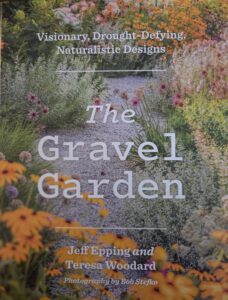
Gravel gardens are the gardens of the present and the future. The Gravel Garden by Jeff Epping and Teresa Woodard, Photography by Bob Stefko (Timber Press) is that book. Offering inspiration, ideas, and common-sense approaches to areas where traditional gardening might prove challenging, gravel gardens are for the present and have a place in future gardens. Many gardeners are struggling to create practical, sustainable, seasonally interesting, and low-maintenance gardens. The Gravel Garden shares examples of how the gardeners featured throughout this book began their gravel journey and why it is a practical approach for today’s gardens.
Creating a gravel garden is a commitment. Plant selection is determined once the proper foundation is selected. Considering drainage issues, lighting requirements, and ongoing maintenance are all factors to consider. Homeowners ready for a change and college campuses are realizing the beauty of simplistic gardens. Durable, sustainable solutions can be beautiful. Public gardens want to share a new way to display diverse gardening techniques. Gravel gardens are an option that gives hope to a new generation of gardeners.
I found myself obsessed with the photographs and found the words convincing. The photographer, Bob Stefko, has quite the eye for capturing beauty in the garden. The photography captures stunning gardens that draw the reader into the page. Both the photos and the words have me considering a gravel garden for a hot, full-sun area in my front yard. Bob Stefko encourages the reader to pause, consider, and dream.
Gravel gardens are a practice that can help reduce water and chemical use. Gravel gardening encourages plant diversity in the landscape. In today’s busy world, the need for beauty with minimal maintenance is exactly what many gardeners are seeking. Public gardens are a great resource. In addition to gravel gardens, public and private gardens educate visitors on diverse garden styles. Today, sustainability is at the forefront of many gardeners’ minds. Easily maintained gardens, brimming with swaths of unexpected beauty and color, are trending.
Public gardens are a wonderful place to enjoy the beauty of gravel gardens. As our weather patterns continue to prove challenging, many gardeners are reconsidering how they garden. Using past practices is becoming more work as our time becomes more limited. A gravel garden offers a way to practice sustainability, low maintenance, and seasonal beauty. The Gravel Garden shares examples of successful installations throughout the world. Places such as the Olbrich Botanical Garden in Madison, Wisconsin, Chanticleer in Wayne, Pennsylvania, and the Mamie Till Forgiveness Garden on Chicago’s South Side.
This book encourages the reader to consider the long-term benefits of a gravel garden. It also considers the ease of maintenance after installation. Beth Chatto and Derek Jarman are pioneers of the gravel garden movement. This book encourages the reader to explore the possibilities and advantages of a gravel garden.
Can you tell I enjoyed this book?